Most conversations about resilience start in the wrong place.
They talk about mindset, discipline, mental toughness or high-performance habits.
But before any of that matters, there’s a simpler question.
Is your base camp set up properly?
Because if the foundations are weak, everything else becomes harder than it needs to be.
Over the years I’ve found that most people struggling with pressure, burnout or mental fog aren’t lacking motivation. What they’re lacking is a simple structure that supports their body and brain.
That’s where what I call the 3-8-45 Base Camp comes in.
It’s not complicated. In fact, that’s the point.
But without it, resilience becomes far harder than it needs to be.

What Is 3-8-45?
The idea is simple.
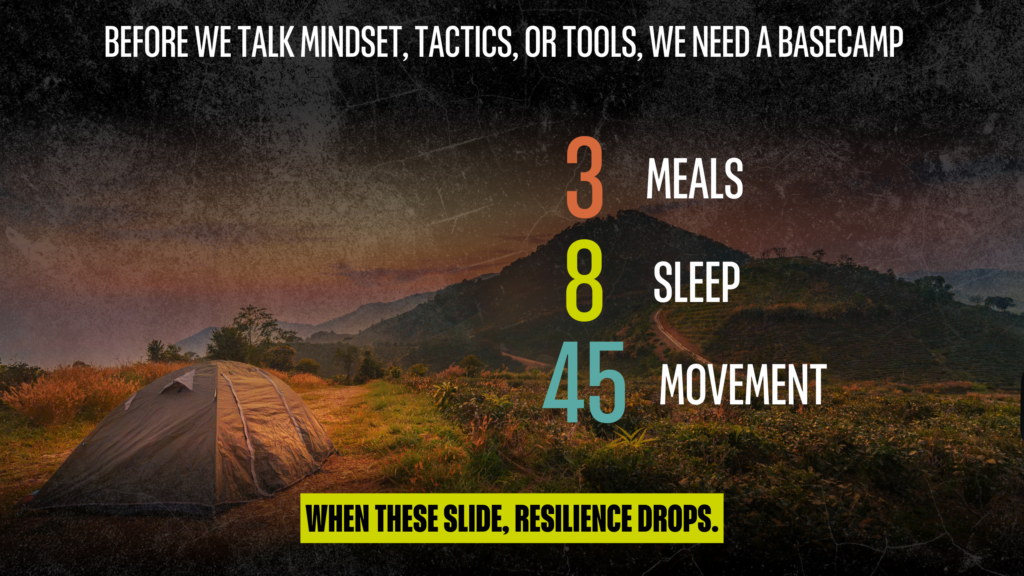
Before chasing optimisation, productivity hacks or complicated routines, focus on three basic foundations.
3 meals
8 hours of sleep
45 minutes of movement
If you consistently hit those three things, you are already ahead of most people trying to manage modern pressure.
This isn’t about perfection. It’s about creating a baseline that keeps your system functioning well enough to deal with the demands of work and life.
Why the Body Matters More Than We Like to Admit
Resilience is often framed as a psychological skill.
But the reality is that resilience is deeply physical.
Your brain is part of your body. The quality of your thinking, mood, decision-making and emotional regulation is strongly influenced by what’s happening in your physiology.
When the body is depleted, the mind struggles.
When the body is supported, the mind works better.
That’s why the Base Camp idea focuses on things that support the brain, nervous system and energy regulation first.
The Gut–Brain Connection
One of the most underestimated aspects of resilience is the relationship between the gut and the brain.
Your gut and brain are connected through what’s known as the gut–brain axis, a communication network that links digestion, immune function and emotional regulation.
A large proportion of the body’s serotonin, a key neurotransmitter involved in mood regulation, is produced in the gut.
When people are skipping meals, eating erratically or fuelling themselves poorly while under stress, it often shows up as:
- brain fog
- irritability
- low energy
- reduced emotional stability
Three proper meals a day sounds basic, but it stabilises blood sugar, supports brain function and helps regulate mood.
It’s not a magic fix. But it’s a powerful foundation.
The Restorative Power of Deep Sleep
Sleep is probably the most powerful recovery tool available to us.
During deep sleep, the brain does several critical things:
- it clears metabolic waste through the glymphatic system
- it consolidates memory and learning
- it regulates hormones related to stress and recovery
- it resets emotional processing
A simple but often overlooked factor here is the sleep environment.
A dark, cool room helps support deeper sleep cycles. Light exposure during the night can disrupt melatonin production and reduce sleep quality.
Many people try to outwork fatigue with caffeine, motivation or discipline. But if sleep is consistently compromised, everything else becomes harder.
Eight hours isn’t always achievable every night, but treating sleep as a priority dramatically improves resilience.
Why Movement Is Non-Negotiable
Movement isn’t just about fitness.
It’s one of the most reliable ways to regulate the nervous system.
Regular movement helps:
- reduce stress hormones
- improve mood through endorphins and dopamine
- increase blood flow to the brain
- improve sleep quality
- support metabolic health
The key is that it doesn’t have to be extreme.
Forty-five minutes of movement could be:
- a brisk walk
- strength training
- Brazilian jiu-jitsu
- a run
- yoga or mobility work
The goal isn’t punishment. It’s keeping the system moving.
Why Base Camp Matters
When people are under pressure, they often try to solve the problem with more effort.
They push harder. Work longer. Sleep less.
But resilience isn’t just about effort. It’s about capacity.
The 3-8-45 Base Camp builds that capacity.
It stabilises your energy, supports your nervous system and gives your brain the conditions it needs to think clearly.
From there, you can build stronger habits around focus, leadership, communication and performance.
But without the base camp, everything else becomes fragile.
Make It Attainable
This isn’t about perfection.
Some days you’ll miss the mark.
The goal is consistency over time.
If you can keep returning to the basics — meals, sleep and movement — you give yourself a foundation that supports resilience in a way that motivation alone never can.
Get the base camp right first.
Build everything else on top of that.
And you’ll already be doing better than most.